The Real Cost of a Pouch
To reduce flexible packaging cost, the first step is understanding where the money actually goes. When a buyer receives a quotation for custom flexible packaging, they usually look at one number: price per pouch.
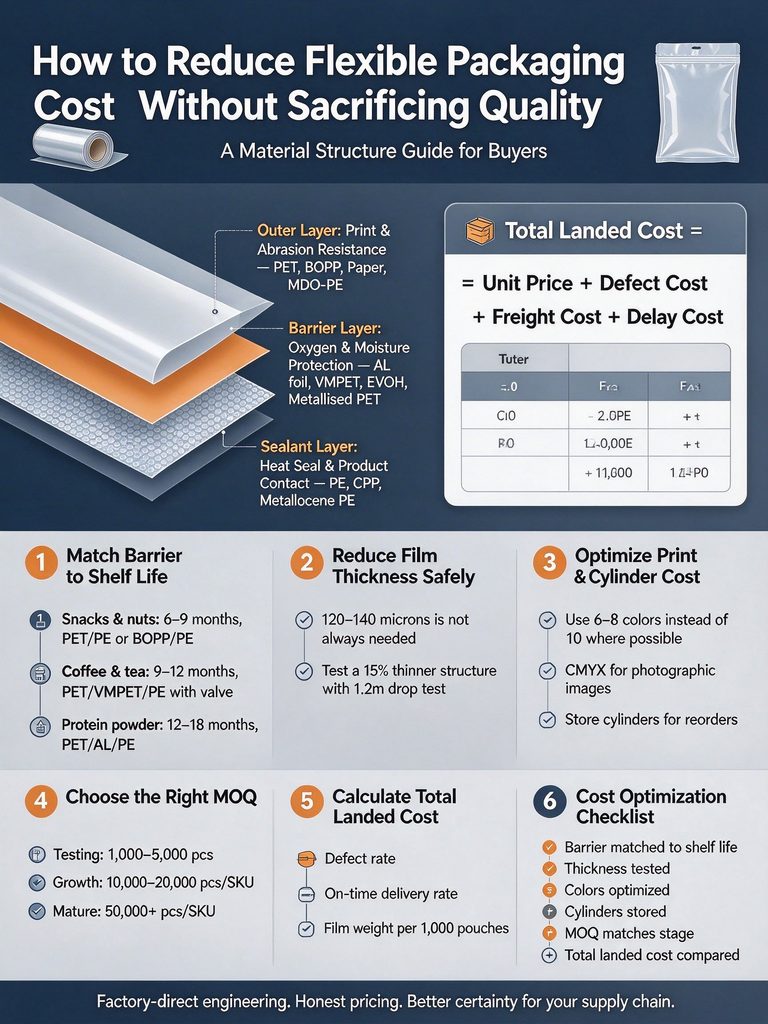
But the price per pouch is only the visible cost. The real cost includes:
Material cost — the film structure, thickness, and barrier layers.
Printing cost — the number of colours and the cylinder engraving fee.
MOQ cost — the minimum order quantity you must commit to.
Freight cost — the weight and volume of the finished pouches.
Quality cost — the cost of defects, returns, and reorders.
In our 15 years of manufacturing, we have found that 80% of packaging cost overruns come from a poorly chosen material structure — not from the printing or the bag-making process.
This guide explains how to choose the right structure for your product, so you can reduce cost without reducing quality.
Step 1: How to Reduce Flexible Packaging Cost by Understanding the Three Layers
Layer Function Common Materials
Outer layer Printing surface, abrasion resistance PET, BOPP, Paper, MDO-PE
Barrier layer Oxygen and moisture protection AL foil, VMPET, EVOH, Metallised PET
Sealant layer Heat sealing, product contact PE, CPP, Metallocene PE
The cost of your pouch is determined by:
The thickness of each layer (measured in microns)
The type of barrier layer (aluminium foil is more expensive than metallised film)
The complexity of the structure (more layers = more lamination cost)
Key insight: You do not always need the most expensive barrier layer. You need the right barrier layer for your product’s shelf life and distribution conditions.
Step 2: Match the Barrier to Your Actual Shelf Life Requirement
Many buyers over-specify their packaging. They choose aluminium foil (AL) when metallised PET (VMPET) would be enough. They choose 140-micron film when 100-micron film would work.
Here is a practical guide:
Product Type Required Shelf Life Recommended Structure Cost Level
Dry snacks, nuts 6–9 months PET/PE or BOPP/PE Low
Coffee, tea 9–12 months PET/VMPET/PE with valve Medium
Protein powder 12–18 months PET/AL/PE High
Pet food 12–18 months PET/VMPET/PE Medium
Sauces, liquids 12 months PET/NY/PE (retort grade) High
Recyclable packaging 9–12 months MDO-PE/PE Medium
Real example: A European snack brand switched from PET/AL/PE (140 micron) to PET/VMPET/PE (120 micron) for their nut packaging. The shelf life remained at 9 months, but the material cost dropped by 18%. Over 500,000 pouches, that saved them over €12,000.
Step 3: Reduce Thickness Where It Is Safe to Do So
Film thickness affects:
Barrier performance
Seal strength
Puncture resistance
Cost (thicker film = more material = higher price)
Many buyers default to 120–140 micron because they are afraid of weak packaging. But if your product is lightweight (e.g., tea, dried fruit, confectionery), a 100–110 micron structure may be sufficient.
How to test: Ask your supplier to produce two sample pouches — one at your current thickness, one at 15% thinner. Fill both with your actual product, seal them, and drop-test them from 1.2 metres (standard retail distribution height).
If both pass, you can safely reduce thickness and save cost.
Step 4: Optimise the Printing to Reduce Cylinder Cost
Cylinder engraving is a one-time cost per colour, per design. If you use 10 colours, you pay for 10 cylinders. If you use 6 colours, you pay for 6.
Cost-saving strategies:
Reduce colour count — Work with your designer to use fewer spot colours. Many premium designs can be achieved with 6–8 colours instead of 10.
Use process printing — CMYK process printing can reproduce photographic images with 4 cylinders instead of 8–10 spot colours.
Reuse cylinders for reorders — If you plan to reorder, store your cylinders with your supplier. Most factories (including ours) offer free cylinder storage for 12–24 months.
Combine SKUs — If you have multiple flavours or sizes, consider using the same cylinder set with different colour rotations. This reduces cylinder cost per SKU.
At Youpin Pack, we engrave our own cylinders using German HELL electronic engraving. This means:
No outsourcing delay
No middleman markup
Full control over cylinder quality and storage
We store cylinders for our customers free of charge for 24 months, so reorders are faster and cheaper.
Step 5: Choose the Right MOQ for Your Stage of Business
MOQ is not just a number — it is a cash flow decision.
Your Situation Recommended MOQ Strategy
New brand, testing market 1,000–5,000 pcs on stock structures
Growing brand, proven product 10,000–20,000 pcs per SKU
Established brand, multiple SKUs 50,000+ pcs per SKU, negotiate annual pricing
Seasonal product Plan 3–4 months ahead, use sea freight
At Youpin Pack, we offer:
5,000 pcs MOQ for custom-printed pouches (standard)
1,000 pcs MOQ on selected stock structures (for trial runs)
Flexible scheduling for brands that want to scale gradually
We do not force our customers into large orders they are not ready for. We grow with them.
Step 6: Consider the Total Landed Cost, Not Just the Unit Price
A pouch that costs $0.08 from Supplier A and $0.10 from Supplier B may actually be cheaper from Supplier B if:
Supplier A has a 3% defect rate, and Supplier B has 0.5%
Supplier A delivers 2 weeks late, forcing you to use air freight
Supplier A’s film is 20% heavier, increasing your shipping cost
Total landed cost = Unit price + Defect cost + Freight cost + Delay cost
When you compare quotations, always ask:
What is the defect rate?
What is the on-time delivery rate?
What is the film weight per 1,000 pouches?
A real factory will answer these questions with data. A trading company will avoid them.
Summary: The Cost Optimization Checklist
Before you finalise your next packaging order, confirm:
□ Barrier layer is matched to actual shelf life (not over-specified)
□ Film thickness is tested at 15% thinner — did it pass?
□ Colour count is optimised (6–8 colours instead of 10 where possible)
□ Cylinders are stored free for reorders
□ MOQ matches your current sales stage
□ Total landed cost is calculated, not just unit price
□ Supplier provides defect rate and on-time delivery data
How We Can Help
At Youpin Pack, we have been manufacturing custom flexible packaging since 2010. We run our own engraving, printing, lamination and bag-making lines in Shandong, China. We do not outsource. We do not over-promise.
If you send us your product specification, we will:
Recommend two material structures — one optimised for cost, one optimised for maximum barrier.
Provide a detailed cost breakdown showing material, printing, cylinder, and freight.
Offer a free digital proof within 24 hours.
Produce a physical sample in 5–7 working days, with the sampling fee refundable against your mass production order.
No pressure. No exaggerated claims. Just factory-direct engineering and honest pricing.