- In 2026, the competition in custom flexible packaging is no longer just about “who can make it,” but “who can make it compliant, flexible, and sustainable.”
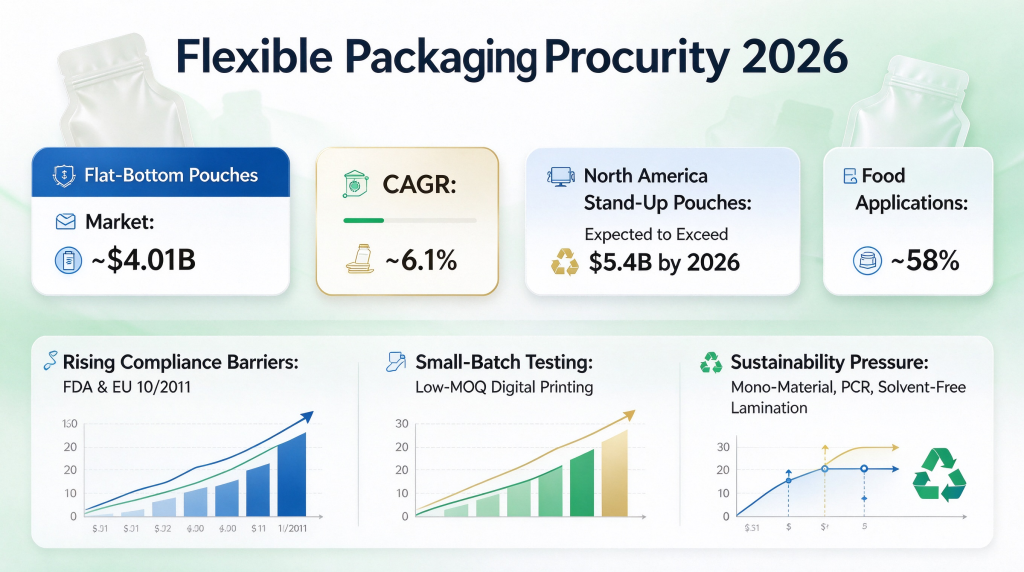
- The global market for flat-bottom pouches is projected to reach approximately $4.01 billion, with a compound annual growth rate (CAGR) of around 6.1%. In North America, the stand-up pouch market is expected to exceed $5.4 billion by the end of 2026, with food applications accounting for about 58%—driven primarily by snacks, coffee, and pet food.
However, brand owners are facing tighter procurement constraints:
Rising Compliance Barriers: Food-contact materials must meet both FDA and EU 10/2011 regulations. Migration testing and traceability are no longer “bonus points”—they are the entry ticket.
Small-Batch Testing is a Must: With faster product launch cycles, brands are unwilling to bet tens of thousands of units on a single market test. Low-MOQ digital printing is breaking the MOQ barriers of traditional gravure printing.
Sustainability Pressure: Mono-material structures, PCR (Post-Consumer Recycled) content, and solvent-free lamination are becoming clear trends in food-grade flexible packaging.
This means that selecting a supplier based solely on “unit price” is no longer enough. You need an evaluation framework covering compliance capability, MOQ flexibility, and supply chain controllability.
4 Core Dimensions for Evaluating Custom Flexible Packaging Suppliers
① Food-Grade Compliance: Look for a “Closed-Loop Chain,” Not Just a Certificate
The risk in food-grade flexible packaging rarely comes from the raw material itself, but from cross-contamination and migration control during printing, lamination, and bag-making. A truly reliable supplier must have:
Food-contact material certifications (ISO 9001, FDA, EU 10/2011).
An in-house lab for seal strength, thickness, migration testing, and traceability verification.
Solvent-free lamination capabilities to eliminate solvent residue risks.
② MOQ and Sampling Efficiency: Deciding if Your New Product Can “Start Light”
Traditional gravure printing usually requires high MOQs, which is unfriendly to test orders. In 2026, digital printing technology is making low-MOQ customization a reality—some factories have lowered their minimum order quantities to the 100–1,000 unit level. When evaluating, confirm:
The actual MOQ for custom printing.
Turnaround time for digital proofs and physical samples.
Whether multi-version, small-batch testing is supported before mass production.
③ Supply Chain Controllability: Factory or Trader? The Result is Completely Different
Quality fluctuations in flexible packaging often occur during the handoffs between design, plate-making, printing, lamination, and bag-making. A factory with its own full supply chain has a structural advantage in quality consistency and delivery certainty. A complete in-house chain should cover: Design → E-plate Making → Gravure/Digital Printing → Lamination → Slitting → Bag-making → QC → Shipping. If any link is outsourced, the boundary of quality responsibility becomes blurred.
④ Sustainability Capabilities: From “Concept” to Deliverable Options
Brand demand for eco-friendly packaging is shifting from slogans to procurement metrics. Supplier capabilities worth noting include:
Mono-material recyclable structures (e.g., all-PE).
PCR content ratio and its food-grade suitability.
Maturity of solvent-free lamination processes.
How Youpin Pack Responds to This Framework
Youpin Pack is a custom flexible packaging factory based in Shandong, China. Established in 2010, we have a 12,000 m² self-owned production base. From design, e-plate making, printing, and lamination to bag-making, everything is completed in-house—no trading companies involved.
Procurement Concerns
Youpin Pack’s Capabilities
Food-Grade Compliance
ISO 9001, FDA, EU 10/2011 compliant materials; in-house lab for seal strength, migration, and traceability testing.
Low MOQ & Fast Sampling
Custom printing starts at 5,000 pcs, some stock structures at 1,000 pcs; digital proofs in 24 hours, physical samples in 5–7 working days.
Print Quality
German HELL electronic engraving and 10-color high-speed gravure printing, 300 m/min, with automatic registration control.
Product Range
Stand-up pouches, 3-side seal bags, flat-bottom/8-side seal bags, spout pouches, roll film, and valve coffee bags.
Sustainability
Solvent-free lamination, recyclable structure options, suitable for food-grade applications.
Our core positioning is simple: “A Factory, Not a Trading Company.” You are communicating directly with the people who design, make plates, print, laminate, and make the bags.
Next Step: Replace “Brochure Evaluation” with “Samples + Quotes”
In 2026 flexible packaging procurement, the most effective way to screen suppliers isn’t reading a PPT—it’s going through a real process.
Submit your bag type, size, material structure, and estimated quantity, and ask for a detailed quote with structural recommendations within 12 working hours. At the same time, request physical samples to verify print precision, seal strength, and material texture.
You can submit your requirements directly at youpinpack.com, or request our food-grade certification documents and sample kits. One sample test is worth more than any supplier whitepaper.
youpin pack