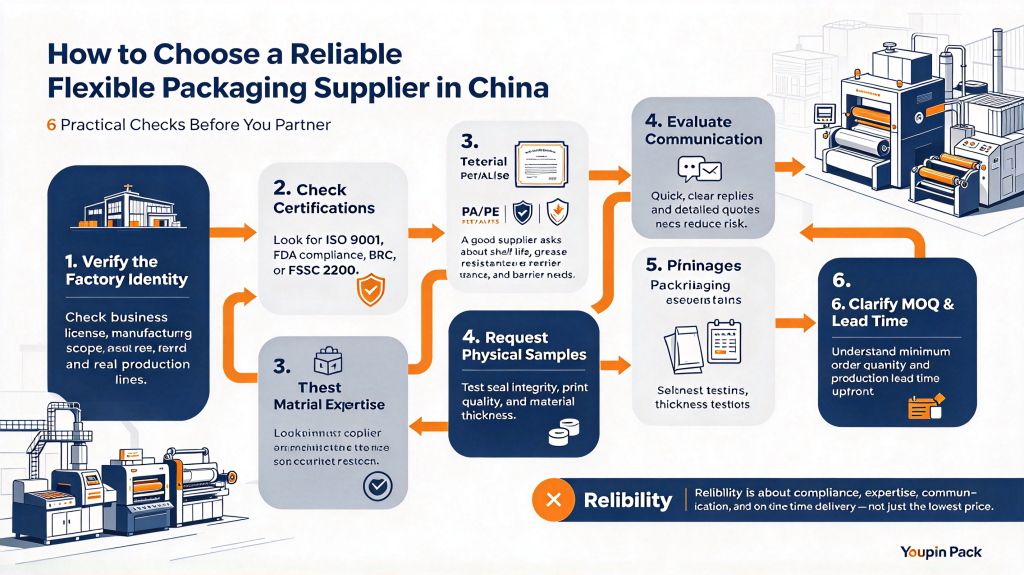
 Finding the right flexible packaging supplier in China can be a game-changer for your food, pet treat, or coffee business. It reduces costs, improves quality, and ensures your product reaches customers safely. However, with thousands of suppliers listed on Alibaba, Made-in-China, and Google, how do you separate the reliable factories from the middlemen?
Here is a comprehensive guide to choosing the right custom flexible packaging manufacturer for your business.
1. Distinguish Between a Factory and a Trading Company
The biggest trap for international buyers is working with a trading company disguised as a factory. Trading companies add an extra layer of cost and often have less control over production quality and lead times.
- How to verify: Ask for their Business License and check if their registered capital and business scope align with manufacturing. Ask for a live video call and request to see their printing machines, lamination lines, and bag-making machines. A real factory (like Youpin Pack) will happily show you around.
2. Check Certifications and Compliance
If you are in the food or pet treat industry, compliance is non-negotiable. Your packaging must protect the product and meet local regulations.
- Look for ISO 9001 (Quality Management), FDA (Food and Drug Administration) compliance for food-contact materials, and BRC or FSSC 22000 if you are selling to major retailers in Europe and the US.
- Always ask your supplier for Food Safety Certificates and Migration Test Reports for the specific materials they use.
3. Assess Their Material Expertise
Not all flexible packaging is created equal. A good manufacturer will ask you about your product’s requirements (shelf life, grease resistance, oxygen barrier) before suggesting a structure.
- For oily foods like fries or chicken, they should recommend grease-resistant paper or PE-coated structures.
- For pet treats that easily oxidize, they should offer high-barrier films like PA/PE or PET/PE.
- If a supplier just says “yes” to everything without asking questions, they are likely just taking your money, not solving your packaging problems.
4. Evaluate Communication and Responsiveness
Time is money in international trade. A reliable supplier responds promptly and clearly.
- Do they understand your technical requirements?
- Do they provide clear quotations (including material structure, thickness, printing costs, and shipping)?
- Are they proactive in offering cost-saving alternatives? If you don’t hear back within 24 hours during the quotation phase, they will likely be unresponsive after you pay.
5. Request Samples Before Placing a Bulk Order
Never place a large order without a physical sample. A reliable supplier will provide a free or low-cost sample so you can test the material, seal strength, and print quality.
- Check the print registration (is it blurry?).
- Test the seal integrity (does it leak?).
- Feel the material thickness (is it flimsy?).
- Pro Tip: Ask for a sample of the exact material structure you plan to use, not just a generic stock sample.
6. Understand MOQs and Lead Times
Every factory has a Minimum Order Quantity (MOQ). For custom printed packaging, the MOQ is usually determined by the printing cylinders. A good supplier will clearly explain their MOQ and production lead times upfront.
- Be wary of unusually low MOQs—it often means they are outsourcing your job to a smaller, unregulated workshop.
Conclusion
Choosing the right flexible packaging supplier is about more than just finding the cheapest price. It’s about partnering with a manufacturer who understands your product, ensures compliance, and delivers on time.
At Youpin Pack, we have over 15 years of experience manufacturing custom flexible packaging for clients worldwide. From design and engraving to printing and bag making, we handle everything in-house. If you are looking for a reliable packaging partner, contact us today for a free consultation and sample quote.