Recently, I came across a short video on Douyin about why pet treats oxidize so easily. The video was brief, but it nailed the point: pet treats usually contain a high amount of fat and protein. Once they come into contact with oxygen in the air, they gradually begin to oxidize. In mild cases, the aroma fades and the texture worsens. In more serious cases, they turn rancid, develop an unpleasant smell, and can even cause digestive upset in dogs. More importantly, many pet owners pour treats into a bowl and leave them out for days, which speeds up oxidation even further.
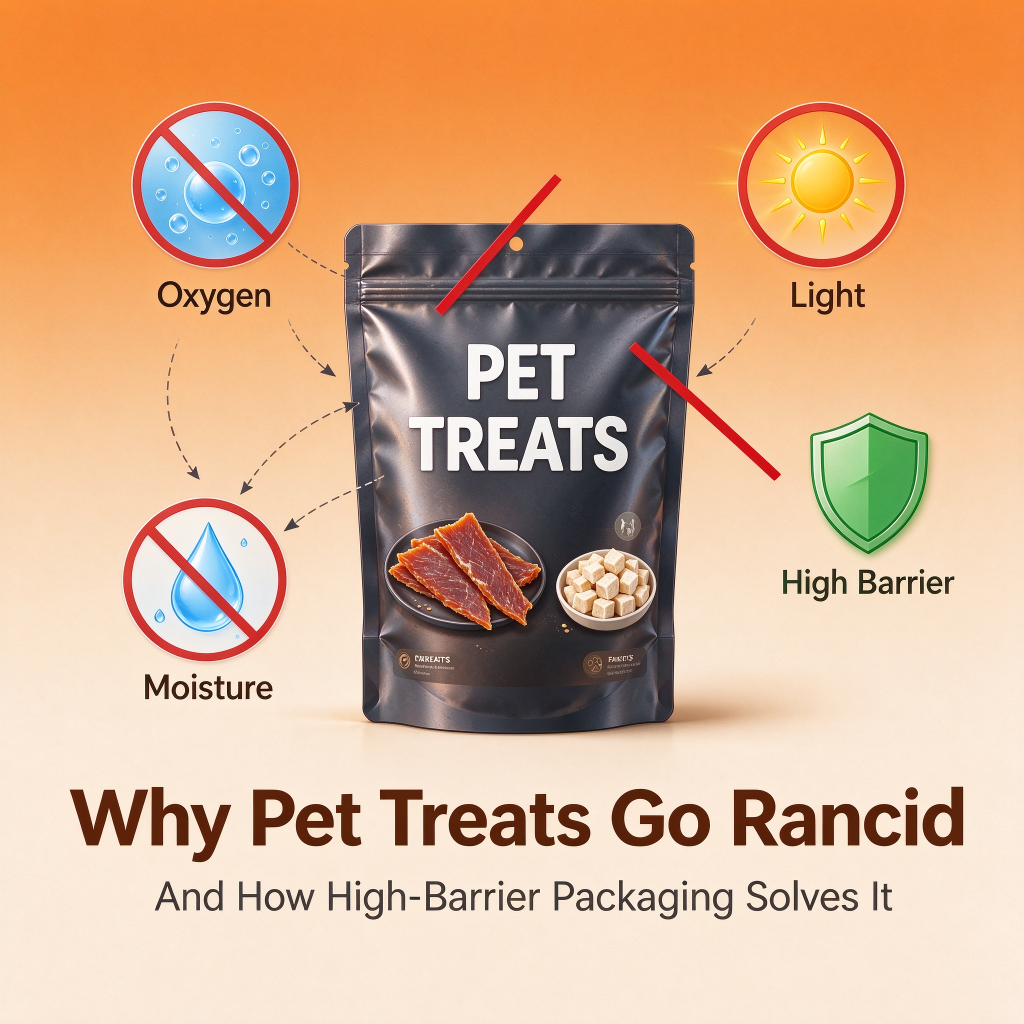
From a packaging perspective, a large part of the oxidation problem mentioned in that video can actually be solved through packaging. Oxidation in pet treats mainly comes from three sources: oxygen, light, and moisture. Ordinary PE bags or single-layer films have limited barrier properties, so oxygen can easily pass through the film and enter the bag. If transparent packaging does not block light well, light exposure will accelerate fat oxidation. If the seal is not tight or the material has poor moisture resistance, moisture will also find its way in.
So what kind of packaging should pet treats actually use? As Youpin Pack, I have worked on packaging solutions for quite a few pet food brands over the years. My usual advice is: high barrier, light-blocking, and well-sealed. Common structures include PET/AL/PE and PET/VMPET/PE. The aluminum foil or metallized layer effectively blocks oxygen and light, while the inner PE layer handles heat sealing and moisture resistance. If a brand focuses on sustainability, MDO-PE/PE mono-material structures can also be used to achieve recyclability while maintaining a certain level of barrier performance. For freeze-dried and jerky treats that are especially prone to oxidation, you can also add an oxygen absorber inside the packaging, or use nitrogen flushing to replace the oxygen inside the bag.
When we design pet treat packaging, we do not just ask, “What size bag do you need?” Instead, we first want to understand: Is it freeze-dried or jerky? What is the fat content? What shelf life is required? What are the transportation and storage conditions? Different products have completely different barrier requirements. Only by choosing the right structure can the treats stay fresh throughout their shelf life and every bite your furry friend takes be safe.
A short video talks about the phenomenon. Packaging has to solve the root cause. I am Youpin Pack, focused on flexible food packaging, from materials to bag making, helping you lock in freshness.